

⚗
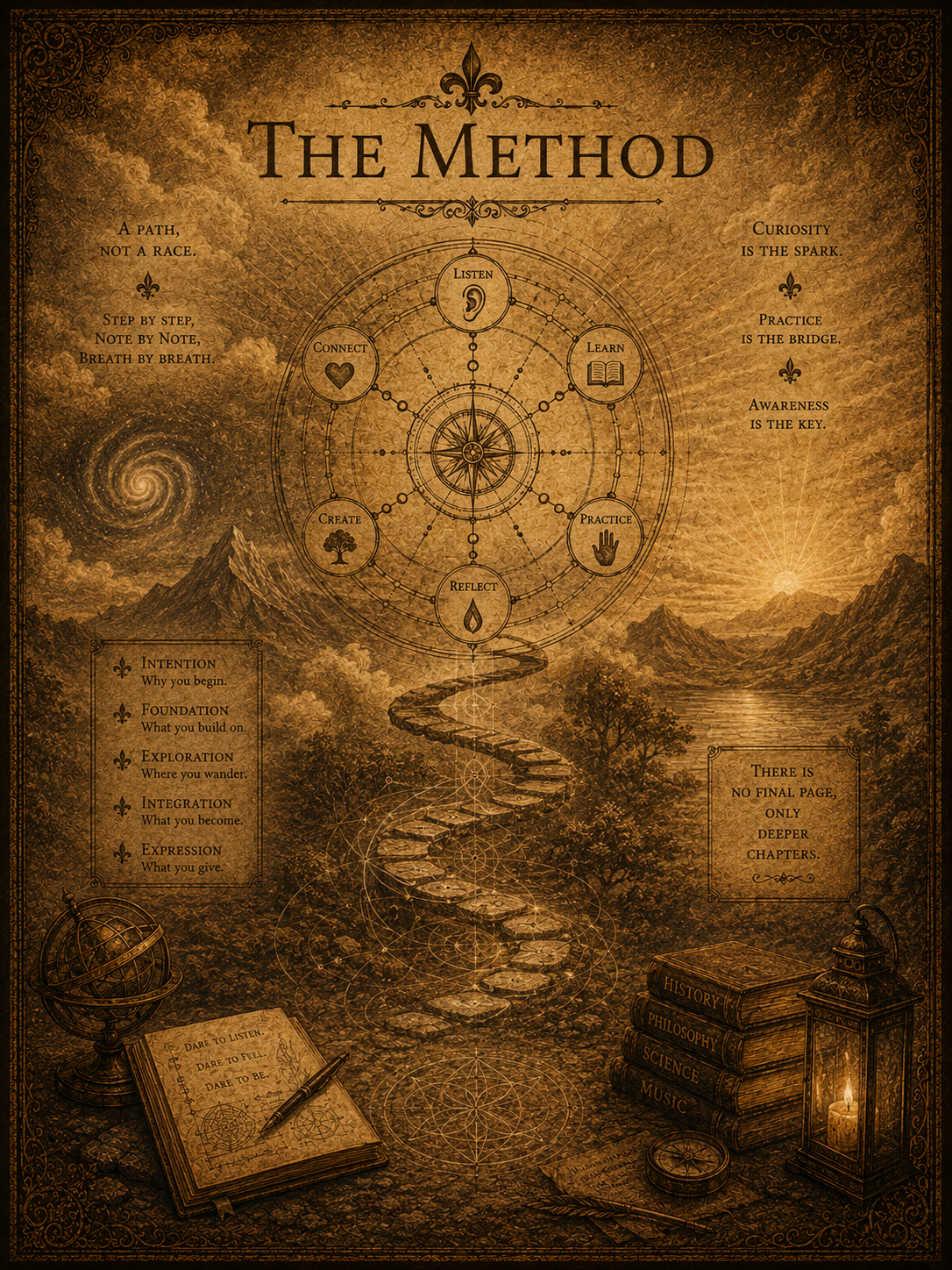
The Method
“To tune the guitar is to tune oneself.”
The Guitar as Healing Vessel
DADF#AD and the Field of Resonance
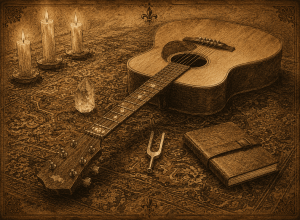
In this work, the guitar is not merely an instrument but a vessel for healing vibration. The DADF#AD tuning loosens the rigid grid of standard guitar harmony, opening a wider, slower field of resonance. Low D and open fifths invite the body to relax; shared tones across the strings create a droning, chapel-like space where sound can linger long enough for the nervous system to recognize it as safety.
Within this field, new chords emerge that are less about functional harmony and more about subtle shifts of color. Shapes move slowly, often by a single finger at a time, so that each overtone has space to rise, blend, and resolve. The guitar becomes a kind of handheld sanctuary, tuned to support listening, breath, and the quiet arrival of insight.
To tune the guitar, then, is to tune one’s own attention. Each string brought into DADF#AD is an invitation to step out of habit and into presence. The act of tuning becomes a short liturgy: listen, adjust, listen again. In this way, the framework of Resonantia Animae is simple—tuning as prayer, resonance as teacher, and the body as the place where these two quietly meet.
——❦ ❦——
The Guitar as Healing Vessel
The Guitar as Lens for Prayer
Resonantia Animae approaches the guitar as a vessel that can be tuned toward prayer. In DADF#AD, familiar chord names fall away, and with them much of the pressure to play correctly. What remains is a gentle invitation: follow the shapes your hands naturally find, listen for how each voicing sits in the body, and allow silence to complete the phrase.
Here, prayer is not a set of words but a posture of attention. A single chord, sustained until it empties into quiet, can carry as much depth as a page of text. Over time, the instrument becomes a trusted companion in contemplative practice: a way to return to the breath, to notice the heart, and to offer whatever is present into sound.
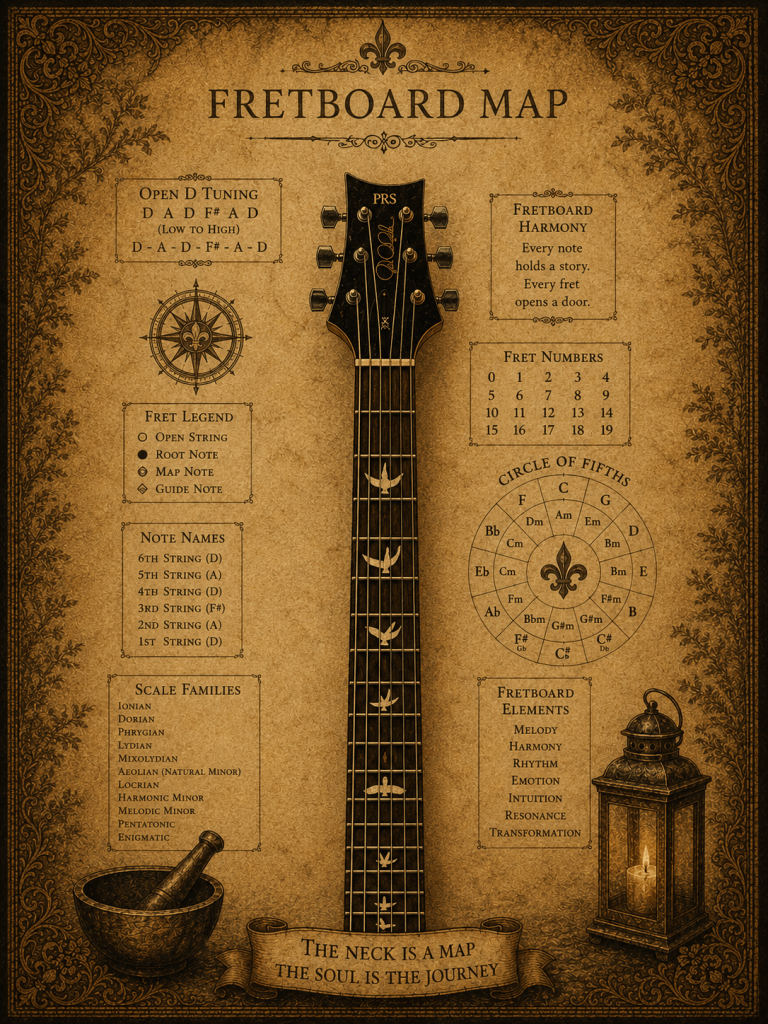
This section of the Method gathers written reflections, diagrams, and scores that illuminate how DADF#AD can shape both inner and outer listening. Each page is an invitation to inhabit the tuning not as a technique to master, but as a landscape to wander.
——◈——
Practice
Simple Resonance Exercises
This portion of the Method offers direct, accessible ways to experience the healing field of the guitar. You need only a few tones and a willingness to listen closely. Begin by tuning to DADF#AD, choosing one string, and letting it ring with a single, intentional breath. Feel where the vibration lands—in the chest, the hands, the jaw—and allow your exhale to follow the fading sound.
From there, you can begin to explore overtones: lightly touching a string at harmonic nodes, noticing how the higher voices shimmer above the fundamental. Slow, spacious chord cycles—often moving between only two or three shapes—invite the whole body to entrain to a calmer rhythm. Listeners, players, and even those who do not think of themselves as musicians are welcome in these practices.
The aim is not performance but attunement. Over time, these simple exercises become a way of checking in with the nervous system, tracking subtle shifts in mood and energy, and honoring what the body knows long before the mind finds words.
⚜

——❧——
 Resonantia Animae