

🧭
Discovery
EXPLORATION · MAPPING · REVELATION
“To discover is not to find something new. It is to hear, for the first time, what has always been sounding.”
INTRODUCTION
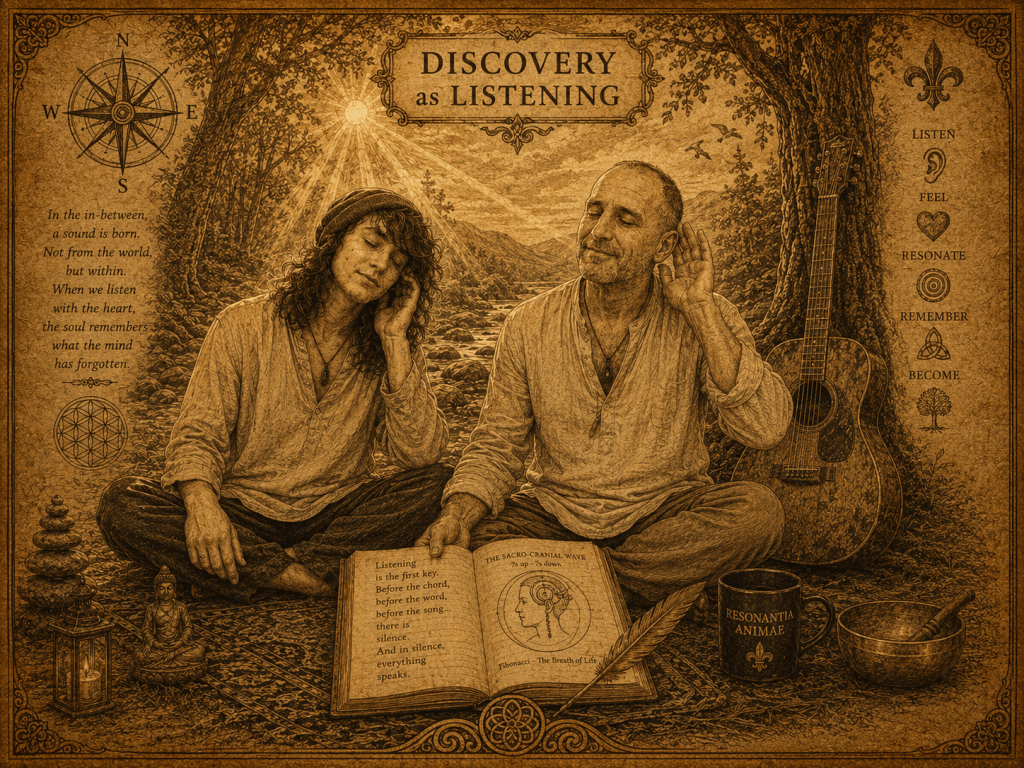
Discovery as Listening
Discovery in Resonantia Animae begins with listening rather than searching. Before new techniques, scales, or theory reveal themselves, the guitar already offers quiet invitations. A string vibrates, a chord lingers a little longer than expected, and a familiar shape suddenly carries a different meaning. In Open D (DADF#AD), the instrument becomes less a machine of notes and more a landscape of relationships. Each position suggests another possibility, encouraging curiosity instead of habit. Progress comes not by forcing answers, but by allowing questions to remain alive. Listening, therefore, is an active practice. Every vibration is information. Every silence is part of the music. Discovery happens when attention becomes deeper than expectation.
——❦ ❦——
THE MAP
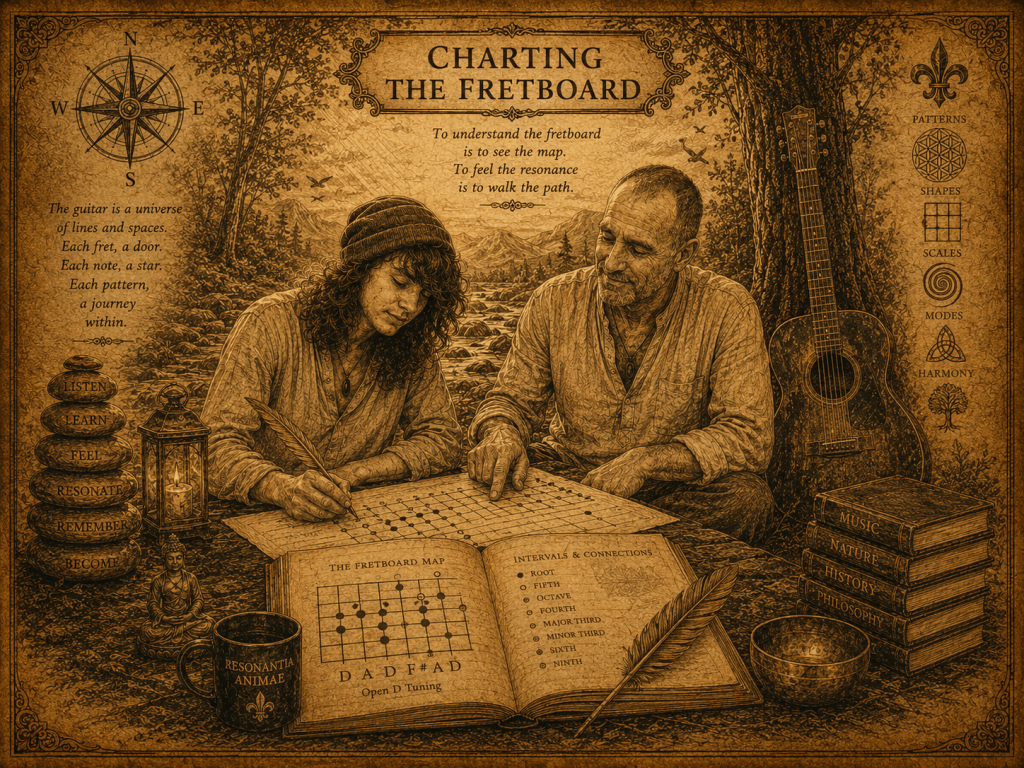
Charting the Fretboard
The fretboard is not a map to memorise but a landscape to explore. Patterns help us navigate, yet they are only signposts. What matters is recognising how each position feels, sounds, and resonates with those around it. Instead of thinking of isolated notes, Resonantia Animae encourages seeing families of sounds. Chords become places, intervals become pathways, and transitions become conversations. Over time the fretboard begins to organise itself naturally in memory because every position carries its own musical identity. The goal is not perfect recall but growing familiarity. Eventually the hand moves with confidence because the ear already knows where the next sound wishes to go.
——❧——
WHAT WAS FOUND
Voicings, Spaces, Thresholds
Every chord contains more than pitches. It contains balance, colour, movement, and silence. Changing a single note can transform tension into peace or brightness into mystery. Learning to hear these differences is one of the central discoveries of this journey. Empty strings create openness. Close intervals create intimacy. Wider intervals create distance and light. None of these choices are better than another; each simply tells a different story. By exploring these subtle relationships, we begin to understand that music is not only built from notes but from the spaces between them. Those spaces invite breath, reflection, and emotion.
——◈——
YOUR OWN DISCOVERY
Listening Beyond the Familiar
Growth begins when we allow ourselves to hear beyond what already feels comfortable. Every new chord, rhythm, tuning, or musical tradition offers another way of understanding resonance. Rather than collecting techniques, we learn to recognise connections. Blues, Celtic music, classical traditions, world music, and modern harmony all become different expressions of the same underlying principle: vibration seeking relationship. The purpose of discovery is therefore not to know everything. It is to remain curious. Every practice session becomes another conversation with the instrument, another step toward hearing more clearly what has always been present.
Questions to carry with you:
- What chord truly surprises you—enough that you hesitate before naming it?
- Where does your hand land in a shape you did not plan, and what if that is the shape that has been looking for you?
- Which resonance keeps returning, uninvited but insistent, asking to become part of your language?
LET THE SOUND FIND YOU.
⚜

 Resonantia Animae